

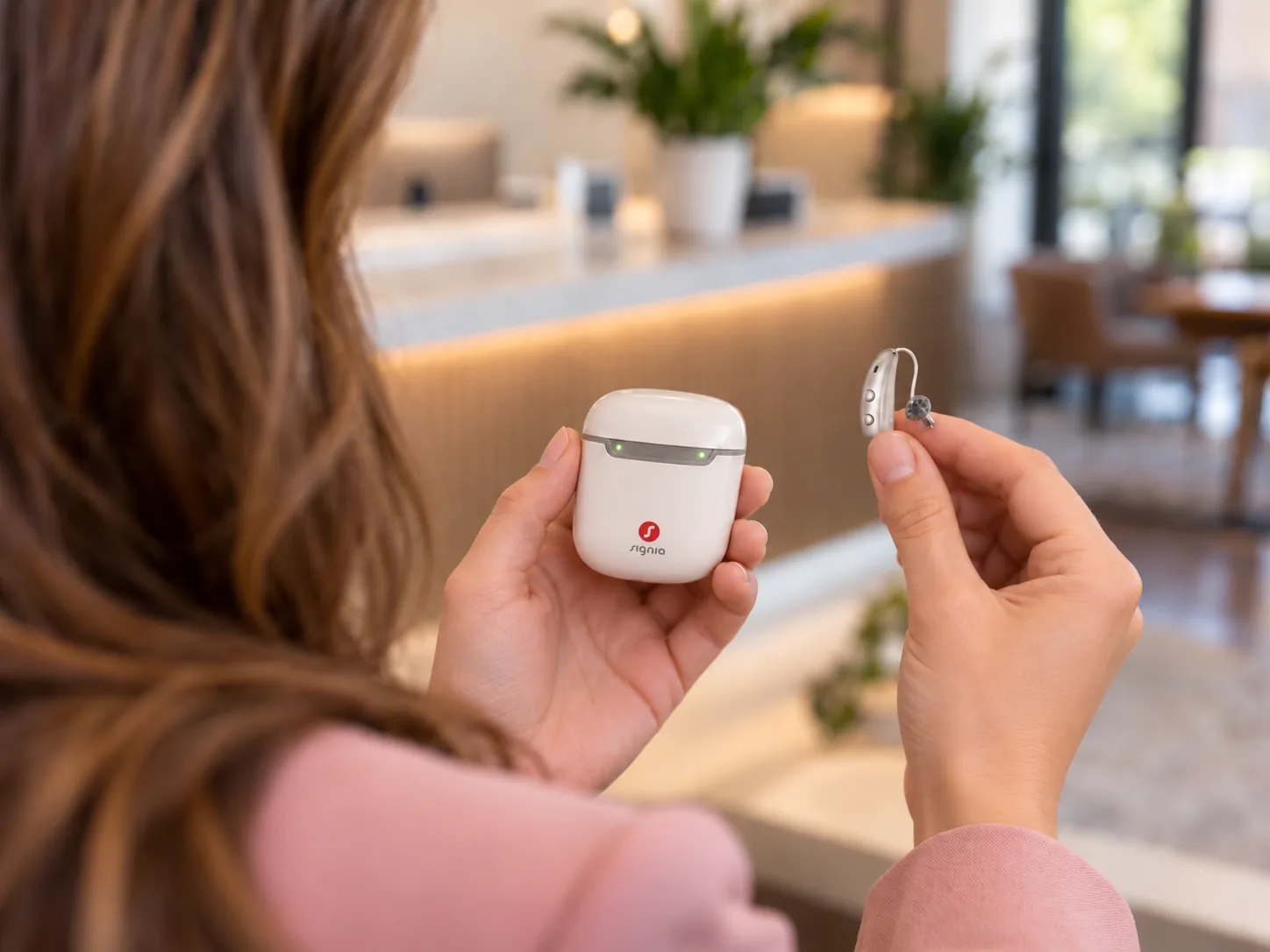
Signia's new MaX platform runs four AI networks at once to follow group conversations in noise. Our founder Riley Williams and the Hello Hearing care team walk through what changed from the IX, how to read Signia's study numbers, and who the Pure Charge&Go MaX 7 is really for.
What you need to know in 30 seconds
- The Pure Charge&Go MaX 7 is Signia's new flagship and the direct successor to the IX. It is in all five of our studios now.
- It runs four specialized AI networks at once, built for the hardest listening situation there is: group conversation in noise.
- Your own voice sounds natural out of the box — no calibration appointment required.
- Up to 30 hours per charge, Bluetooth for iPhone and Android, a telecoil for hearing loops, and Auracast-ready hardware.
- Signia's own study numbers are impressive but company-funded; the independent HearAdvisor lab scores the MaX 4.3 out of 5, grade A. Come hear it for yourself — every fitting includes our 45-day risk-free trial.
If you ask our patients where their hearing aids let them down, almost nobody says "in my living room." They say the restaurant. The family dinner. The meeting where three people talk at once. Group conversation in noise is the hardest thing we ask a hearing aid to do, and it is the one place where even very good devices still fall short.
That is exactly the issue Signia built its new platform to solve. The Signia Pure Charge&Go MaX 7 started shipping in the United States on August 24, and it is now in all five of our studios. Our providers have fit it, worn it, and spent real time with the research behind it. Here is our read on what it does, what is actually new, and how to interpret the numbers Signia is putting out.
Where this fits in the Signia lineup
MaX stands for Multi-adaptive Xperience, and it replaces Signia's Integrated Xperience, or IX, platform from 2023. If you wear a Pure Charge&Go IX today, this is its direct successor. The 7 in the name is the technology level: MaX comes in 7, 5 and 3, with 7 being the full feature set. At launch the only style is the Pure Charge&Go, a rechargeable receiver-in-canal (the small style that sits behind the ear with a thin wire into the canal), in eight colors. It is the same basic shape as the IX and a touch fuller in the body.
The reason this is a platform launch and not a refresh is the chip. Signia's own figures put it at 54 times the processing power of IX, twice the memory, and 50 percent better energy efficiency. The chip itself is not the story, though. What matters is what Signia built with all of that new headroom.
Four networks instead of one
Every premium hearing aid now uses a deep neural network, a piece of AI trained on recorded sound, to decide what is speech and what is noise. Most run one network that has to do everything. Signia's approach on MaX, which it calls Acoustic Intelligence, is to run four narrower networks at the same time and let them share information: one that detects speech, one that detects your own voice, one that analyzes the overall scene, and one that handles noise. Signia says they were trained on 40 million sound samples across 11 languages and six music genres.
From a clinical standpoint the interesting part is not the count. It is that the networks are specialized. A system that knows the difference between your voice and a stranger's voice, and knows whether you are in a car or a cafe, can make decisions a single general-purpose network cannot. That shows up in four features Signia has named:
RealTime Conversation Enhancement. This is the headline. It tracks multiple talkers around you and follows the conversation as it moves, rather than locking onto whoever is in front.
Own Voice Processing. Signia has handled own-voice separately since the Nx days, but on IX it required a calibration step in the clinic. On MaX the own-voice network recognizes you immediately, no calibration needed.
Ambient Scene Adaptation. The scene network is always running, so the device is continuously updating its picture of the room instead of waiting for a program change.
Dynamic Noise Control. Noise reduction that scales with whether there is a conversation happening. Signia's tagline for this platform is "live noisy," and the idea is that noise is not the enemy when it is not competing with speech.
Underneath those, the MaX 7 runs an updated SoundSmoothing 2.0 for sudden sounds like dishes and doors, and eWindscreen 2.0 for wind.
What our providers notice most in the fitting room is how little there is to touch. On IX, the first appointment usually meant dialing in own-voice and a noise program by hand. On MaX the starting point is already close.
The numbers, and how to read them
Signia has published more data on MaX than we usually see at launch, and it deserves an honest walkthrough, because these are Signia-commissioned studies and that context matters.
The clearest figure: in a group conversation in noise, 97 percent of wearers performed better with MaX than with competing premium devices, and MaX ranked first in signal-to-noise ratio, roughly a 3 decibel advantage. In a study at ORCA USA, Signia's American research lab, speech understanding was 10 to 20 percentage points higher than competitors. A separate study at the Hörzentrum in Oldenburg, Germany found a 19 to 34 point advantage depending on the competitor. All of those figures come from Signia's own 2026 research.
Here is how we read them. A 3 decibel signal-to-noise improvement is real and clinically meaningful. It is roughly the difference between following a conversation and giving up on it. The percentage-point gains are remarkable for a single generation, and the independent HearAdvisor lab has since added its own weight: the MaX earned a 4.3 out of 5 SoundScore with an A grade. The lab numbers line up with what our fitting rooms have been telling us — this platform was built for exactly the situations people struggle with most.
What the fitting room tells us
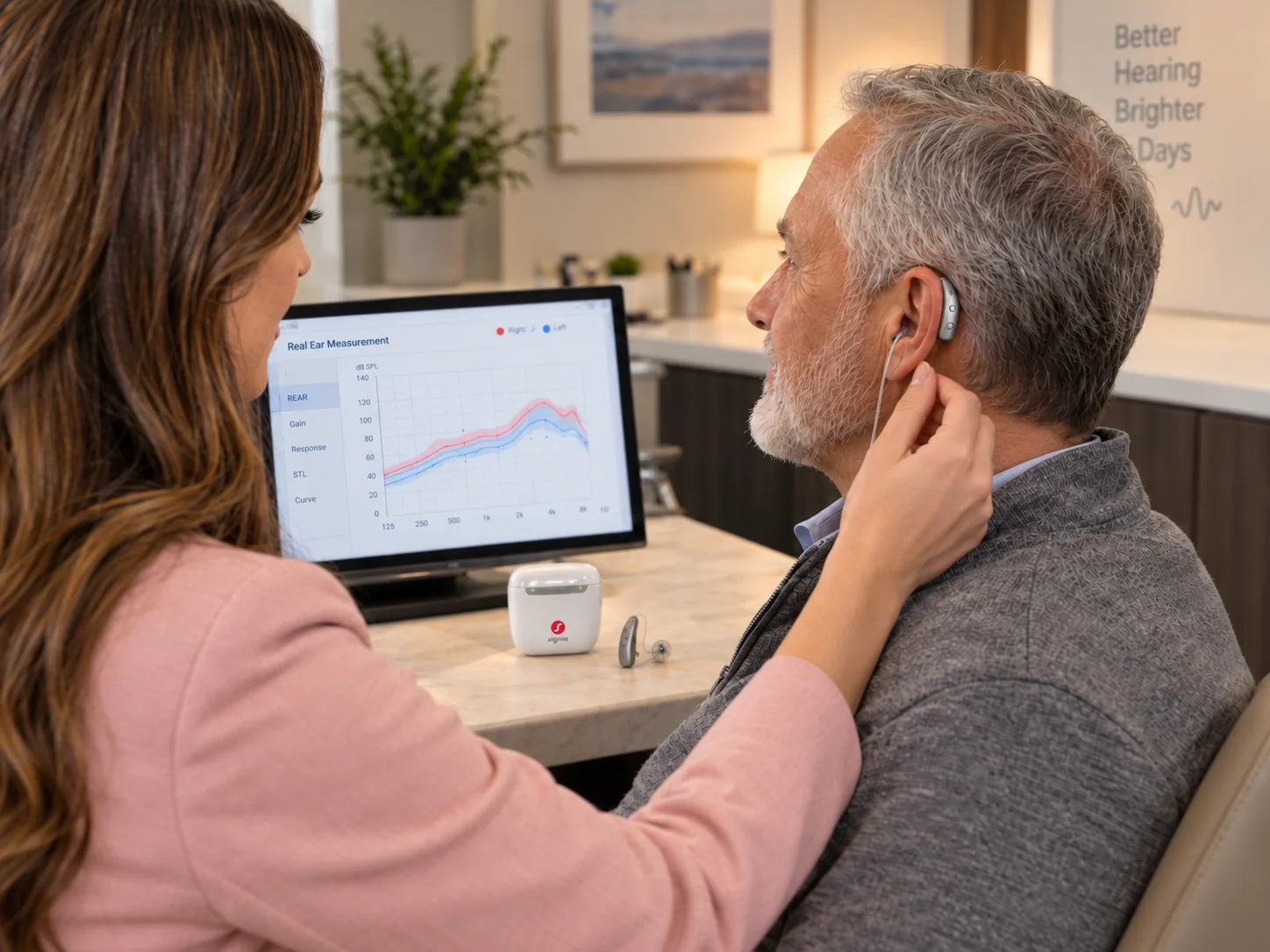
We run every new device through the same process: real-ear measurement first, then a scripted walk through a quiet room, a busy front desk with the door open, a phone call, and a step outside. Here is what stood out.
The own-voice change is the biggest quality-of-life improvement and it is the least glamorous. The number one complaint in a first-fit appointment is "my voice sounds strange." MaX handles it out of the box, and in our fittings so far we have not had to revisit it. That means the first week is spent enjoying the device instead of adjusting to it.
In the busy room, the conversation tracking is noticeably steadier than IX. When a second person joined from the side, the device brought them in without dropping the first voice. It is not magic, and a very loud room is still a very loud room, but the transition is smoother than anything else we fit.
One thing we want to be plain about: the body is slightly larger than IX. Most patients will not notice. If you chose IX specifically because it was the smallest device you could get, mention that and we will talk through it together.
Battery, phones and Auracast
Signia rates the MaX 7 at up to 30 hours on a charge; heavy streaming will trim that, but a full day with margin is realistic. A full charge takes about four hours, and 30 minutes in the charger buys roughly six hours. It ships with a pocket-sized portable charger that holds four full charges on its own, so a long weekend without an outlet is fine. One tradeoff worth knowing if you are coming from an IX, which was rated up to 39 hours: MaX gives up a little battery headroom in exchange for the much bigger processing jump, and still comfortably covers a full day.
On connectivity Signia calls the setup OneConnect: Bluetooth Classic, Bluetooth LE Audio, a telecoil, and Auracast broadcast audio. The telecoil matters more than it gets credit for: if your church or theater uses a hearing loop, MaX connects to it directly, same as always. Streaming works with both iPhone and Android. One caveat worth knowing: Auracast, the new broadcast standard showing up in venues and airports, is built into the hardware, but full functionality arrives by firmware update, which Signia has scheduled for March 2027. The app is the Signia One App, and the Signia Assistant now takes plain-language questions for troubleshooting.
Two compatibility notes for existing Signia patients. The MaX works with the Signia TV Sound streamer. It does not currently work with the StreamLine Mic remote microphone, and there is no MaX-compatible remote mic yet.
Who we would put in MaX 7
This is a device for people whose hard moments are social. If you do fine one-on-one and struggle at the table, in church, at a meeting, at the game, MaX 7 is built for you, and the evidence lines up with that use case specifically. It is also a good fit if own-voice has been a persistent complaint on previous devices, and for anyone who wants to be ready for Auracast without buying again next year.
If you are happy in a Signia IX and your difficult situations are under control, you do not need to upgrade this month. IX is still a very good hearing aid and we will keep fitting it. MaX also comes in 5 and 3 technology levels on the same platform, and we can talk through which level actually fits your life.
Hear it in a noisy room, on purpose
The right way to evaluate MaX 7 is not in a quiet booth. Come in, bring your current hearing aids, and we will run them side by side in the loudest part of the studio. Every fitting combines an expert hearing test and real-ear measurement with the new technology in the device, so you get a personalized, comfortable fit — plus cleanings, follow-up adjustments and our 45-day risk-free trial: if it does not solve the problem you brought it in for, you bring it back. Book a visit online or call — let's check out the difference together!
Riley Williams, BC-HIS, is the founder of Hello Hearing Studios and a Board-Certified Hearing Instrument Specialist. She and the Hello Hearing provider team completed Signia's clinical training on the MaX platform and have been fitting the Pure Charge&Go MaX 7 across all five Colorado studios since its U.S. release.