


Phonak's new EON platform is smaller, lighter and runs up to 38 hours, and it already has an independent lab score. The Hello Hearing specialist team answers the questions first-time buyers and Infinio wearers keep asking: what improved, what does the battery really do, and Sphere or R?
What you need to know in 30 seconds
- EON is Phonak's new platform, replacing the Infinio Ultra line: three models on the new HYPERSONIC chip, in all five of our studios now.
- The flagship Audéo EON Sphere is 25 percent smaller, 20 percent lighter, and rated at up to 38 hours per charge — plan on roughly 22 hours on a heavy streaming day, still a full day with margin.
- It is the rare launch that already has an independent lab score: HearAdvisor rated it 5.0 out of 5, grade A.
- Auracast broadcast audio works today, and every fitting includes our 45-day risk-free trial.
Phonak does not launch a new platform quietly, and EON is no exception. It arrived in our studios the last week of August, three models on one new chip, with a stack of claims and, unusually for a launch, an independent lab score already attached. Our specialists have spent the weeks since fitting it across our studios and wearing it ourselves.
Rather than walk through the spec sheet top to bottom, we have organized this around the questions patients actually ask. What is it. What actually improved over last year's Infinio. What does the battery really do. And which of the three do I want.
What EON is, in one paragraph
EON is Phonak's new hearing aid platform, released in the United States on August 24, 2026, and it replaces the Infinio Ultra line, which itself succeeded the original Infinio Sphere from 2024. Three devices launched together: the Audéo EON Sphere, which is the flagship with Phonak's dedicated speech-in-noise AI; the Audéo EON R, a conventional rechargeable receiver-in-canal (the small style that sits behind the ear with a thin wire into the canal) for people who do not need that processor; and the CROS EON R for single-sided hearing loss. All three run on a new chip Phonak calls HYPERSONIC. They come in three technology levels, 90, 70 and 50, and eight colors. The shells are IP68 rated for dust and water and, on the Sphere, 25 percent smaller and 20 percent lighter than the previous generation.
What actually improved over Infinio
The Infinio Ultra Sphere is barely a year old, so it is fair to ask what one more generation actually buys you. The honest answer has three parts.
The speech-in-noise engine got a version bump, not a rebuild. Spheric Speech Clarity, the neural network that pulls a voice out of a loud room, is now version 3.0. Phonak's supporting number is the same one it has used since the original: wearers are twice as likely to understand every word from any direction with Spheric on than with identical settings and Spheric off. That figure comes from a 2024 Phonak field study and it is about the feature versus no feature, not EON versus Infinio.
The automatic program switching got meaningfully smarter. AutoSense OS AI 8.0 samples the room hundreds of times a second, and the change we care about is subtle: it now uses separate thresholds for entering and leaving the Speech in Loud Noise program. On 7.0 the device could flicker in and out of the noise program at the edge of a restaurant. Phonak's testing shows about 20 percent more time in the right program on 8.0, and that matches what we hear in our studios.
The chip is the real story. HYPERSONIC runs Spheric 3.0 at 37 percent lower power than Infinio Ultra ran Spheric 2.0. That is where the smaller shell, the lighter weight and the 38-hour battery come from. If the previous Sphere's size, or its battery at the end of a heavy day, was ever the complaint, that is exactly what EON fixed.
Our rule for anyone already wearing an Infinio: if it is working for you, keep it. If you have been running Spheric all day and charging every night with nothing to spare, come try EON. That is the person it was built for.
Someone has already tested it independently
This is the part we want to highlight, because it is rare. HearAdvisor, the independent lab that scores hearing aids on a standard set of recordings, has already run the Audéo EON Sphere 90. It earned a 5.0 out of 5 SoundScore with an A grade. Speech in noise scored 4.5, about two and a half points above the category average. Feedback handling was 4.6. Speech in quiet 4.3. Streaming music 3.7.
The one soft spot in the report is own-voice comfort at 2.8. Phonak does not do a dedicated own-voice network the way some competitors do, and if the sound of your own voice has bothered you on previous devices, that is something we will spend time on at the fitting. It is manageable, but it is real, and we would rather tell you here than at appointment three.
The battery, with honest math
Phonak rates EON at up to 38 hours on a single charge, which is the highest number on a rechargeable RIC right now. The number you should plan around is lower. With eight hours of streaming and time in loud noise, Phonak's own math comes out to roughly 22 hours. That is still a full day with margin, and it is a real improvement over Infinio Sphere, which could get tight on a heavy day.
A full charge now takes about two and a half hours, down from three. There are two chargers: the ChargerGo RIC I E, a portable case with its own battery for travel, and the Charger RIC E for the nightstand.
Phones and Auracast
Phonak's connectivity pitch has always been Made For All: Bluetooth Classic that talks to nearly anything — iPhone, Android, laptop, TV, smartwatch — with up to eight paired devices, two connected at once, and hands-free calling. New this generation is Auracast, the broadcast audio standard arriving in theaters, airports and public venues, and it is live on EON now. One small note for iPhone users: joining an Auracast broadcast currently works by scanning the venue's QR code rather than picking from an on-screen list the way Android does — a quick extra step, and one we are happy to walk through at your fitting. Roger Direct, Phonak's remote microphone system, is still built in. Controls are a tap gesture on the shell, a button and volume rocker, and the myPhonak app for everything else.
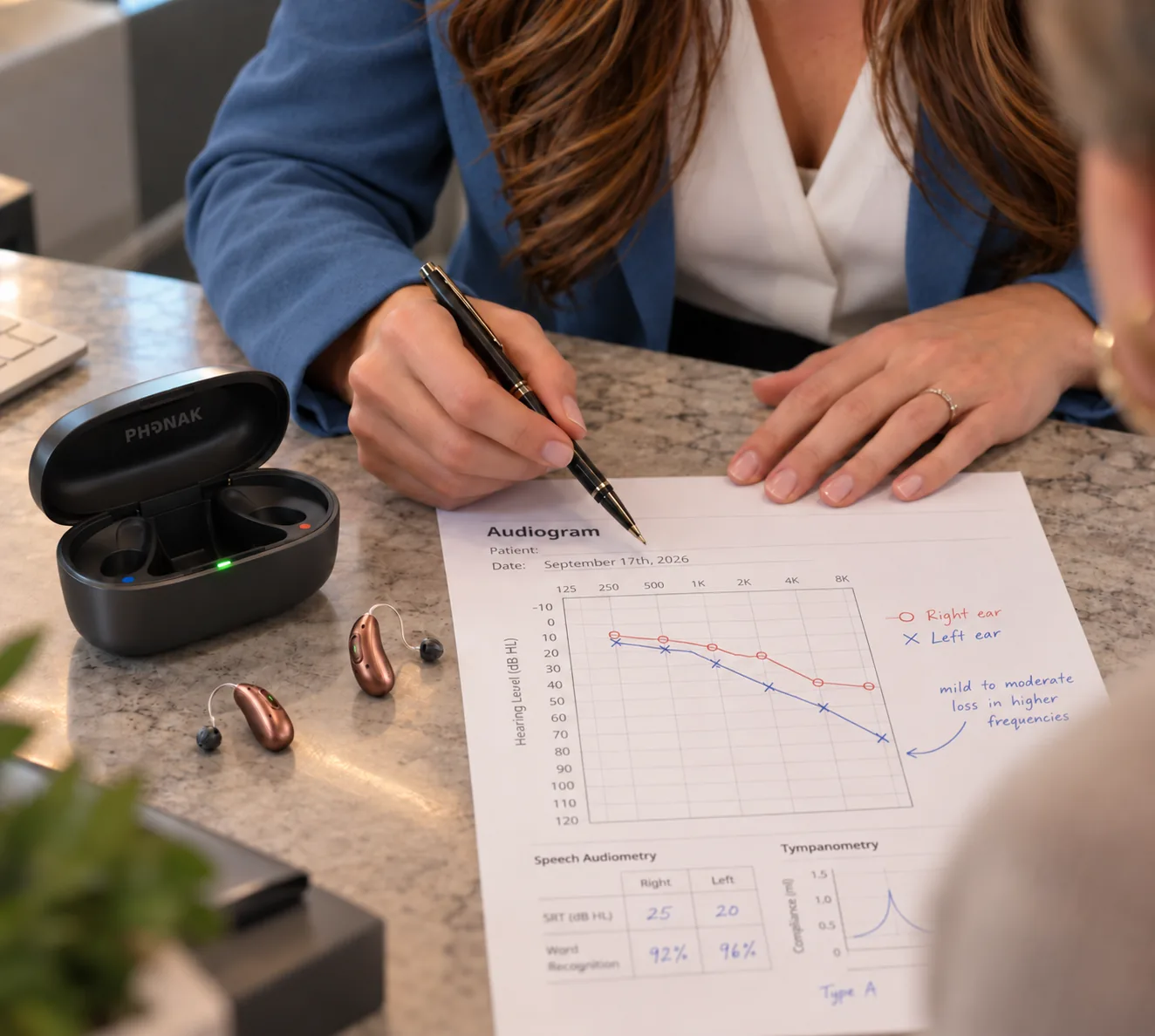
Sphere or R: how to choose
The Sphere and the R share the chip, AutoSense 8.0, WindBlock 2.0, the battery and the Bluetooth. What the Sphere adds is Spheric Speech Clarity, the dedicated speech-in-noise processor. So the question is simple: how much of your life happens in loud rooms?
If loud rooms are where your week falls apart — the restaurant patio, the holiday table, the bleachers — get the Sphere. That is what you are paying for and the lab data backs it up. If your difficult moments are mostly quiet-to-moderate, if you are retired and social in smaller groups, or if you simply do not need the extra processor, the EON R gives you almost everything else. We fit plenty of both.
A Colorado note on WindBlock 2.0, which both models have. Phonak rates it at up to 50 decibels of wind noise reduction with the feature on, and in a small study 90 percent of participants preferred it over the first version. On the Front Range, that is not a footnote. It is one of the first things we demo.
Come try it against your own
EON is in all five studios. If you are wearing an Infinio, bring it, and we will run the two in the same conversation so you can hear whether the difference is worth it to you. If you are new to hearing aids, this is one of the strongest starting points on the market right now, and you are not betting on it blind: every EON we fit combines an expert hearing test and real-ear measurement with the new technology, for a personalized, comfortable fit — plus cleanings, follow-up adjustments, and a 45-day risk-free trial we put in writing before you decide. If it is not the right device, it comes back. Book online or call, and mention EON so we set aside the time.
Published by the Hello Hearing Studios specialist team. Our specialists completed Phonak's EON clinical training and have been fitting the Audéo EON Sphere and EON R across all five Colorado studios since their U.S. release.